 1. Who are the short fiction authors you admire (Australian or otherwise, alive or dead)?
There are so many: Colm Tóibín, Alice Munro, Jhumpa Lahiri, David Malouf, Banana Yamamoto, Amy Kempel, Keri Hulme. Haruki Murakami has had the most influence on my own writing in recent years.
2. What is the most memorable short story you have read? And why does it stand out for you?
I will never forget Katherine Brush’s ‘Birthday Party’. It showed how important language is in showing emotion. More recently Murakami’s ‘Man-Eating Cats’ inspired a story in Damaged in Transit.
3. What do you like about the short story form?
First, the brevity. I like having the idea for a story in my head and playing around with it, imagining how characters might think or speak, how they came to be the way they are, how they might change. Second, I see the language of short fiction as being similar to that of poetry where every word matters and contributes to the meaning and effect of the whole.
I greatly admire novel writers but cannot imagine tackling something so large unless it was structured as a series of loosely linked short stories.
4. How would you describe your own writing?
Several of my stories look at the ways people might be shaped or damaged by their circumstances, sometimes with humorous or unbelievable results. I think this style has evolved from my interest in science fiction, dystopias, fantasy, and magic realism. Some readers describe my writing as quirky and I like that.
5. Which of your stories are you most fond of right at this moment and why?
‘Train Train’ (in Damaged in Transit) makes me feel good when I read it. It’s about a young couple who are pulled apart by their experiences on a train that exists for no one but them. I keep wondering what the story is about.
I am also attached to ‘Yum Cha’, a story in progress about a woman and her ex at an exhibition where the art works all resemble food.
6. Where do the ideas for your stories come from? (Take us through an example)
Melbourne’s public transport system is a wonderful source of story ideas. The sounds and rhythms of trams and trains stir ideas that don’t come when walking or sitting at a desk. And there are so many people to observe and speculate about. I saw a metal-studded young man in goth gear carrying a plate that held a good sized slice of delicious looking pie. Who made the pie? When will he eat it? How does it feel wearing all those studs and jewellery? Does he feel as cross as he looks?
Other stories develop from snippets in the news like a brief report about a man who swum the length of the Amazon. I thought he’d have to be mad to do something like that, and the character in my story ‘Amazon Man’ is funny but decidedly mad.
7. What is your writing process – from idea to publication? (Do you go it alone or are others involved?)
I write lots of scraps and put them in a file (called ‘bits’) which I search through if I’m short of ideas. If I find something with possibilities I might add a couple of hundred words and see if it’s going anywhere. If it isn’t I’ll save it put it away for another time. Then I’ll procrastinate for quite a time, plant some beans, make a curry, and finally get organised with notebook and pencil and catch a train to an unfamiliar suburb where I’ll sit in a mall, jot down words and images, sketch people or take photos.
At home I always work with the radio on. I rarely write by hand and don’t print the first draft until is more or less finished. Then I read it aloud in my head and move things around so the sentences sound better. This is a good time to apply the ‘less is more’ rule–take out all the adverbs, sharpen the dialogue, remove repetition and so on.
It can take weeks to get a draft ready for my writing group to critique and I get a bit desperate when the deadline approaches. Then, at the last minute, when it’s too late to make major changes I might realise that the point of view is all wrong, or the story would be better in present tense or the voice is flat. Or worse, that the whole story is silly.
My writing group is invaluable. Each of us has a distinctive writing style and set of interests. We ask the questions that matter: do you need this character? What does X expect to gain by this action? Would the story be better told in Y’s point of view? There is nothing to prepare us for Z’s behaviour here. We are constructive and encouraging. I always leave thinking my story is not silly at all but needs quite a lot of work.
8. Do you feel the short story form is valued in Australia? What makes you say this?
It is hugely valued by many readers although I sometimes feel it is an underground movement. There is very little in mainstream media about stories and it us up to writers, readers and festivals to spread the word. You only have to look at the fiction edition of The Big Issue which sells out quickly and is held in high regard.
9. How do you feel about your work being published in non-print forms such as digital and audio?
It’s wonderful to live in a time where it is possible to read in many ways. I read on my phone, eReader, iPad and books, of course. Stories are words– it does not matter how you read them. I think everyone will adapt to reading in different ways just as children do.
10. What advice would you like to offer Spineless Wonders?
More please. You are doing a great job.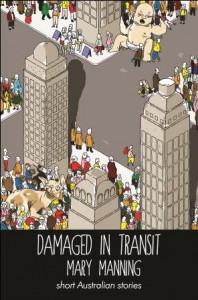
Mary Manning lives in Melbourne and is a writer of short stories, poetry and educational texts. Her stories have been awarded in the Victorian Fellowship of Writers and published in Eureka Street magazine. Her poetry has been published and awarded in competitions and published. She is author and co-author of several books for senior secondary school students, research reports on adult education and study notes on fiction, poetry and plays.Her interests are reading, particularly of contemporary fiction, film, music, overseas and outback travel. Damaged in Transit is due for release in November, 2012.
Follow Us:





Share this page:
